
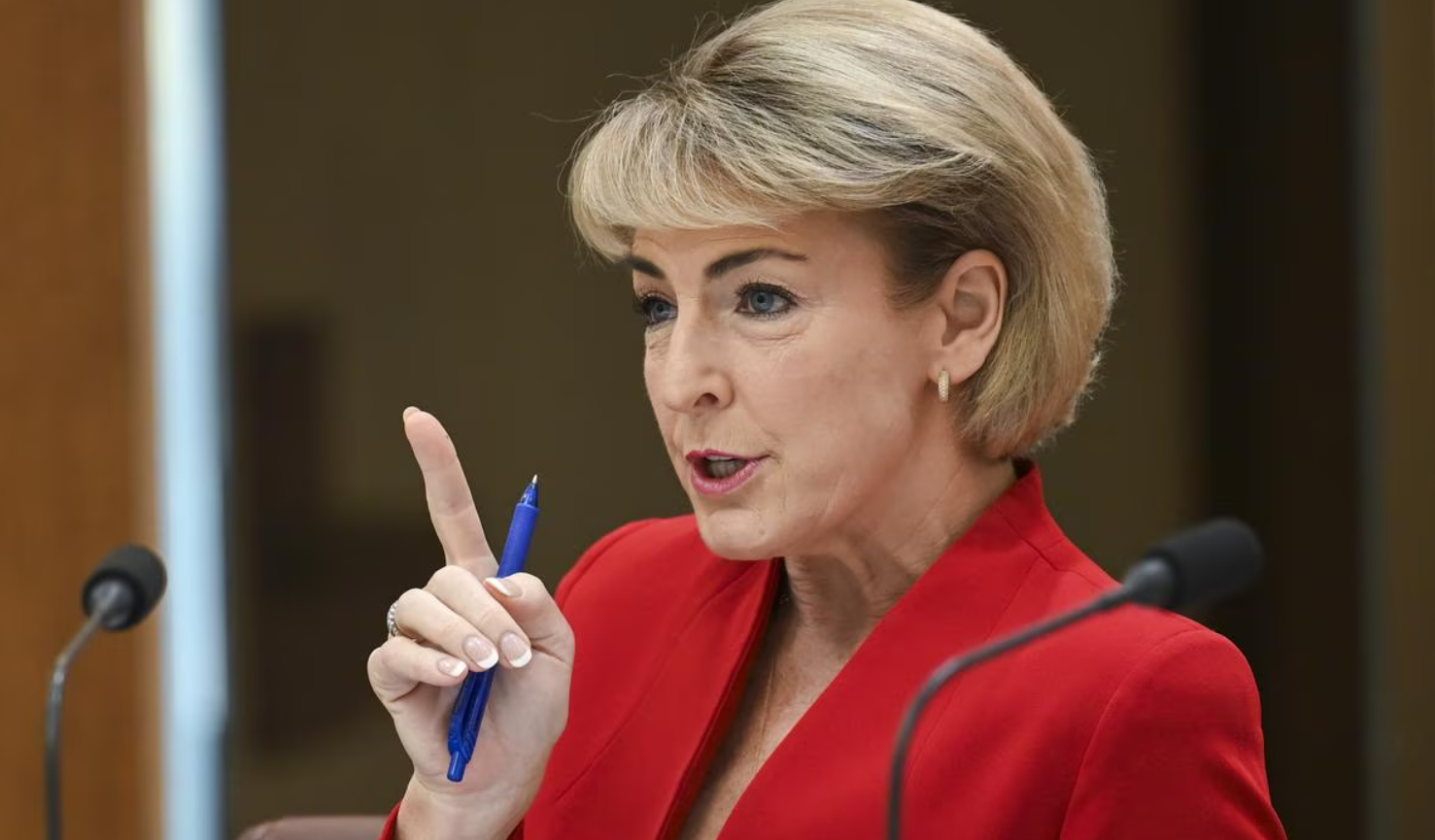
Michaelia Cash has spent nearly two decades at the centre of Australian federal politics. Born in Subiaco, Western Australia, in 1970, she entered the Senate after building a professional career in law and years of involvement with the Liberal Party. Since her election in 2007, she has held portfolios covering immigration, employment, workplace relations, small business and law, eventually serving as Australia’s Attorney-General.
Her career illustrates a traditional but increasingly uncommon route into senior politics: extensive party involvement, professional experience, parliamentary committee work and a gradual progression through junior and senior ministerial responsibilities.
As of 2026, Cash is Leader of the Opposition in the Senate and again serves as Shadow Attorney-General, placing her among the most senior Liberal figures in federal Parliament.
A Background in Law
Before entering federal politics, Cash developed a substantial legal career. She completed a Bachelor of Arts at Curtin University of Technology, an honours law degree through the University of London and a Graduate Diploma in Legal Practice at the University of Western Australia. She subsequently worked as a solicitor and became a senior associate at the law firm Freehills.
That legal background would later prove particularly relevant to her parliamentary responsibilities. Employment law, industrial relations and the Attorney-General’s portfolio all involve complex legislative frameworks in which legal training can provide a significant advantage.
At the same time, Cash had been involved with the Liberal Party for many years before entering Parliament. Parliament records her membership of the Western Australian Liberal Party from 1988, along with numerous positions within the Young Liberals and state party organization.
Entering the Senate
Cash was elected to represent Western Australia in the Senate in 2007, with her term beginning the following year. She was subsequently re-elected in 2013, 2016 and 2022.
Her early parliamentary work included committee responsibilities and opposition portfolios involving immigration and the status of women. These roles allowed her to build expertise in policy areas that would later become important when the Coalition returned to government.
The Senate is a particularly important environment for developing detailed legislative knowledge. Unlike the House of Representatives, where governments usually possess a working majority, Senate negotiations frequently determine whether legislation survives, changes or fails.
Entering Government
Following the Coalition’s victory in 2013, Cash became Assistant Minister for Immigration and Border Protection and Minister Assisting the Prime Minister for Women. Two years later, she was promoted to Cabinet as Minister for Employment and Minister for Women.
Employment would become one of the policy areas most closely associated with her career. Industrial relations in Australia involves recurring disputes over wages, unions, employer responsibilities, workplace protections and the appropriate level of government regulation.
These questions naturally produce ideological conflict between Labor and the Coalition, as well as between unions and employer organizations. Cash’s strong communication style made her a prominent advocate for the Coalition’s approach.
Employment, Skills and Small Business
Cash subsequently held a series of portfolios involving jobs, innovation, skills, vocational education and small business. Parliament records her as Minister for Jobs and Innovation from late 2017, followed by responsibilities for small and family business, skills and vocational education.
Although these portfolios may appear separate, they are closely connected. Governments attempting to increase employment must consider not only the number of available jobs but whether workers possess the qualifications businesses require.
Vocational education is particularly significant in Australia because industries including construction, resources, manufacturing and services depend heavily on skilled trades. Policies affecting apprenticeships and training therefore have direct consequences for both employers and workers.
Becoming Attorney-General
In March 2021, Cash reached one of the highest points of her ministerial career when she became Attorney-General of Australia. She simultaneously served as Minister for Industrial Relations until the Coalition left government in May 2022.
The Attorney-General is Australia’s first law officer and holds responsibility for major components of the Commonwealth legal system. The portfolio therefore brought Cash’s political career back into direct contact with her original profession.
Holding the Attorney-General and industrial-relations responsibilities simultaneously also placed her at the intersection of law and workplace policy—two areas that had defined much of her professional and parliamentary development.
Transition to Opposition
After Labor won the 2022 federal election, Cash moved from government to the opposition frontbench. She became Deputy Leader of the Opposition in the Senate and Shadow Minister for Employment and Workplace Relations, later adding the role of Shadow Attorney-General.
The transition from minister to shadow minister changes the nature of political work. Ministers must administer departments and defend government decisions, while opposition figures focus on scrutinizing legislation and presenting alternatives.
Cash’s extensive ministerial experience made her an important figure in that process, particularly when Labor introduced significant workplace-relations reforms.
Leadership in the Senate
In January 2025, Cash became Leader of the Opposition in the Senate. Her responsibilities consequently expanded beyond individual policy portfolios to the broader management of Coalition strategy in the upper chamber.
The role requires detailed knowledge of parliamentary procedure and negotiation. Governments that lack an outright Senate majority frequently need support from opposition parties or crossbench senators, giving Senate leaders an important role in determining the progress of legislation.
Her responsibilities evolved again following subsequent changes to the Coalition frontbench. Parliament’s current record lists Cash as Leader of the Opposition in the Senate and Shadow Attorney-General.
A Career Shaped by Law and Workplace Politics
Michaelia Cash’s political trajectory has been unusually consistent in its central themes. Law, employment, workplace relations and the Liberal Party organization have repeatedly intersected throughout her professional life.
Her supporters often emphasize her experience and effectiveness as a parliamentary advocate, while opponents strongly challenge many of the industrial-relations policies she has defended. That division reflects the inherently contested nature of workplace policy rather than simply Cash’s personal political style.
After entering Parliament in 2008, she has survived multiple changes of prime minister, Coalition governments, an electoral defeat and subsequent leadership transitions.
That longevity has transformed her from a relatively new Western Australian senator into one of the Liberal Party’s most experienced federal parliamentarians. Her current leadership position demonstrates that her influence extends beyond the portfolios she has individually held: Michaelia Cash has become one of the figures responsible for shaping the Coalition’s broader strategy inside the Australian Senate.
