
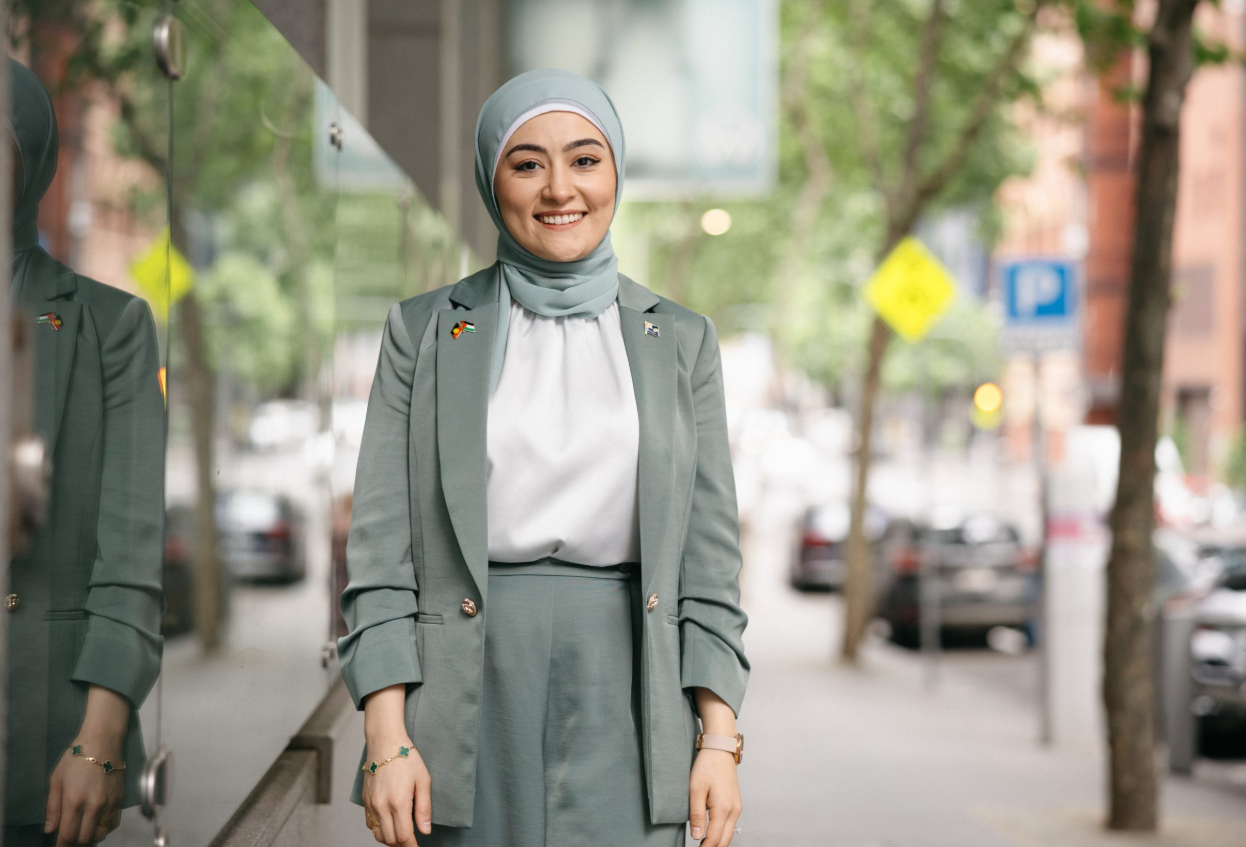
Fatima Payman’s political career represents one of the more remarkable personal journeys in contemporary Australian politics. Born in Kabul, Afghanistan, in 1995, she eventually settled in Australia and entered federal politics at a young age. In 2022, she was elected as a Senator for Western Australia, becoming a prominent representative of a generation whose backgrounds differ substantially from those historically associated with Australia’s federal political establishment.
Her career subsequently took an unexpected turn. Initially elected as a member of the Australian Labor Party, Payman left Labor in 2024, sat as an independent and later established Australia’s Voice. As of 2026, the Australian Parliament lists her as a Western Australian senator representing Australia’s Voice.
From Kabul to Australia
Payman’s early life began far away from Canberra. Born in Afghanistan, she came from a family that sought a new future in Australia. Her background became an important part of her political story because it connected questions of migration and multiculturalism with her own personal experience.
She studied at the University of Western Australia, completing a Bachelor of Arts and a graduate diploma in pharmaceutical science. Before entering Parliament, she worked as a pharmacy assistant, electorate officer and organizer for the United Workers Union. These positions provided experience both in ordinary workplaces and within political organizations.
Her involvement in Labor politics also developed through the party’s youth and multicultural organizations. She served as secretary of the Multicultural Labor Branch and became president of Young Labor in Western Australia in 2021.
Entering the Australian Senate
Payman was elected to represent Western Australia in the Senate in 2022. Her election attracted attention partly because of her age and background. At a time when Australian institutions were increasingly discussing representation and diversity, her arrival provided a highly visible example of demographic change within federal politics.
Once in Parliament, she served on committees dealing with subjects ranging from migration and employment to foreign affairs, disaster resilience and artificial intelligence. Committee work rarely receives the same public attention as parliamentary speeches, but it forms an important part of a senator’s responsibilities.
For a new parliamentarian, these assignments also provide exposure to policy areas far beyond the issues most closely associated with an election campaign.
The Break with Labor
The defining political development of Payman’s first Senate term arrived in 2024. Differences between her position and that of the Labor government over the Israel-Gaza conflict created an increasingly serious internal dispute.
Payman crossed the Senate floor to support a motion related to recognition of a Palestinian state, placing her in direct conflict with Labor’s caucus position. The episode generated extensive national attention because party discipline has traditionally been particularly strong within the Australian Labor Party.
In July 2024, Payman resigned from Labor and became an independent senator. According to the Australian Parliament’s official record, her Labor membership ended on 4 July 2024.
The episode transformed her national profile. A senator who had previously been known partly for the symbolic importance of her election was suddenly at the centre of a major debate about party discipline, foreign policy and individual political conviction.
Creating Australia’s Voice
Payman did not remain an independent indefinitely. In October 2024, she became associated with Australia’s Voice, a political organization intended to provide an alternative to the established major parties. Parliament records her membership of Australia’s Voice from 9 October 2024 and currently lists her as the party’s whip.
Creating or developing a new political movement is considerably more difficult than leaving an established party. Major Australian parties possess organizational infrastructure, experienced staff, donors, volunteers and established voter bases. A new organization must build these structures while simultaneously explaining what differentiates it from existing alternatives.
For Payman, this meant transitioning from dissident Labor senator to a politician attempting to establish an independent political identity.
Representation and Generational Change
Payman’s story also raises broader questions about representation. Her Afghan background, Muslim identity and comparatively young age made her arrival in Parliament culturally significant for communities that historically saw relatively few people with similar backgrounds in federal politics.
Representation, however, creates complicated expectations. Politicians from minority communities may be expected simultaneously to represent an electorate, a political party and communities with which they are personally associated. These expectations do not always point in the same direction.
Payman’s break with Labor demonstrated that tension dramatically. Her supporters viewed her decision as an example of acting according to conviction, while critics questioned her political judgment and relationship with the party under whose banner she had been elected. Those competing interpretations remain part of the discussion surrounding her career.
A Political Story Still Being Written
Fatima Payman is considerably earlier in her political career than most nationally recognized Australian politicians. That makes definitive judgments about her long-term influence premature.
What is already clear is that her first years in Parliament have been unusually eventful. Within a short period, she moved from newly elected Labor senator to a nationally debated dissident, independent parliamentarian and representative of a new political organization.
Her future will depend on whether she can convert personal recognition into durable political support. Regardless of the outcome, her trajectory already illustrates several important changes taking place in Australian politics: greater demographic diversity, declining automatic loyalty to traditional parties among some voters and growing interest in politicians willing to establish identities outside conventional party structures.
